
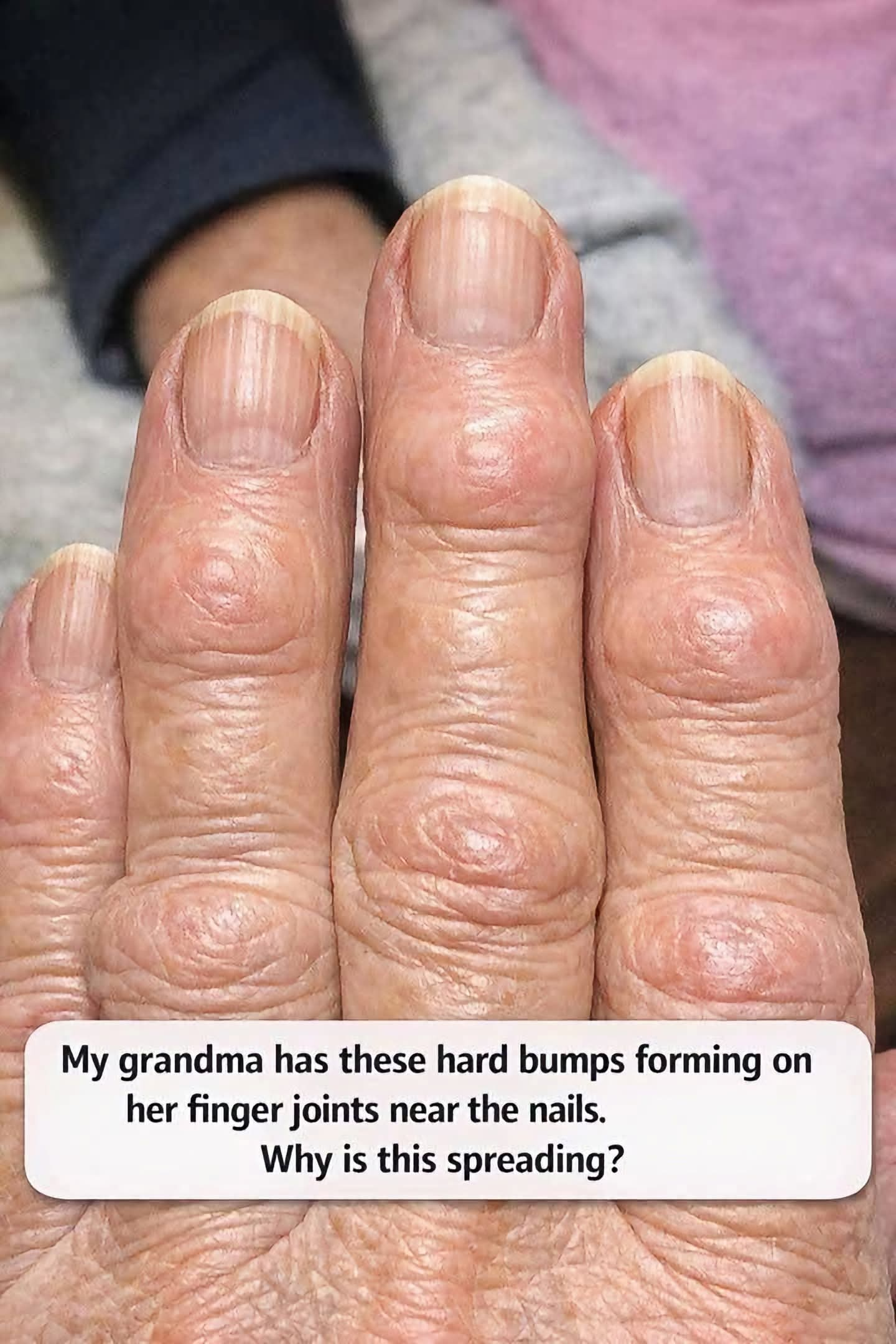
Hard Bumps on Finger Joints Near the Nails: What They Could Mean
Have you noticed hard bumps on the finger joints near the nails and wondered what they are? These small, firm enlargements can become more noticeable with age and may affect one finger or several fingers. Sometimes they cause no pain at all, while in other cases they can be associated with stiffness, tenderness, swelling, or changes in finger movement.
One common explanation is Heberden’s nodes, which are bony enlargements that develop at the distal interphalangeal (DIP) joints—the joints closest to the fingertips. They are commonly associated with osteoarthritis of the hands.
Although these bumps can look concerning, their appearance alone doesn’t tell you exactly what is causing them. Understanding where the bumps occur, how they feel, whether they are painful, and whether other symptoms are present can help determine whether medical evaluation is appropriate.
What Are Those Hard Bumps on Finger Joints Near the Nails?
Hard bumps that develop on the joints closest to the fingernails are often bony enlargements associated with osteoarthritis.
The joints closest to the fingertips are called the distal interphalangeal joints, or DIP joints. When osteoarthritis affects these joints, bony enlargements called Heberden’s nodes may develop. Similar bony enlargements on the middle finger joints are known as Bouchard’s nodes.
These changes can make the fingers look wider or irregular around the affected joint. Some people have little or no discomfort, while others experience pain, stiffness, swelling, or reduced range of motion.
Importantly, not every bump on a finger is a Heberden’s node. A healthcare professional can determine the most likely cause based on the appearance, location, symptoms, medical history, and, when needed, imaging or other tests.
Heberden’s Nodes: A Common Cause of Finger Joint Bumps
Heberden’s nodes are hard, bony prominences that occur at the DIP joints of the fingers.
They are considered a characteristic feature of hand osteoarthritis. Osteoarthritis can affect the cartilage and other tissues within a joint, and over time the joint can change shape. Small bone growths called osteophytes, or bone spurs, can develop around affected joints.
When these changes occur at the joints closest to the fingertips, the resulting bony enlargements are called Heberden’s nodes.
They may appear gradually and can affect multiple fingers.
Heberden’s Nodes vs. Bouchard’s Nodes
The location of a bump can provide an important clue.
- Heberden’s nodes: Affect the DIP joints closest to the fingertips.
- Bouchard’s nodes: Affect the proximal interphalangeal (PIP) joints in the middle of the fingers.
- Hand osteoarthritis: Can affect the DIP and PIP joints as well as the joint at the base of the thumb.
So if the hard bump is right next to the fingernail, Heberden’s nodes are one possible explanation.
How Osteoarthritis Can Create These Bony Bumps
Osteoarthritis is a condition in which tissues within a joint gradually undergo structural changes and breakdown. It commonly affects the hands, knees, hips, and other joints.
Healthy cartilage helps provide a smooth surface where bones meet. With osteoarthritis, cartilage and other joint tissues can deteriorate over time.
As the joint changes, the body may develop additional bone around the joint. These bony growths are called osteophytes or bone spurs.
In the fingers, these changes can create the firm bumps associated with Heberden’s and Bouchard’s nodes.
This is why the bumps can feel very different from ordinary soft-tissue swelling.
What Do Heberden’s Nodes Feel Like?
Heberden’s nodes can vary from person to person.
Some people may notice:
- Firm or hard bumps at the ends of the fingers
- Enlarged finger joints
- Stiffness
- Pain or tenderness
- Swelling around the affected joint
- Reduced finger movement
- Changes in the shape or alignment of the finger
However, not everyone with these bony enlargements experiences significant pain. Hand osteoarthritis can range from relatively mild symptoms to changes that interfere with everyday activities.
Simple tasks such as opening jars, fastening buttons, gripping objects, or using small tools can become more difficult when pain and stiffness affect hand function.
Why Do These Bumps Become More Common With Age?
Osteoarthritis becomes more common as people get older, although aging alone does not mean someone will necessarily develop painful arthritis.
According to the National Institute of Arthritis and Musculoskeletal and Skin Diseases (NIAMS), osteoarthritis is more common in older adults, and the hands are among the joints commonly affected. Women are also more likely than men to develop osteoarthritis, particularly after age 50.
Other factors can also contribute to osteoarthritis risk, including previous joint injury, repetitive joint stress, joint structure, and family history.
This means that seeing finger-joint changes in an older family member isn’t necessarily unusual—but new or bothersome symptoms still deserve attention.
Can the Bumps Spread From One Finger to Another?
It may appear as though the bumps are “spreading” when additional finger joints become affected over time.
Hand osteoarthritis can involve multiple joints, including several DIP and PIP joints.
However, the appearance of new bumps doesn’t necessarily mean that one bump physically spread to another finger.
Instead, different joints can develop osteoarthritis-related changes independently.
If new bumps continue to appear, particularly if they are painful or accompanied by swelling or loss of movement, it’s reasonable to have the hands evaluated.
Are Hard Finger Bumps Always Osteoarthritis?
No.
Heberden’s nodes are strongly associated with osteoarthritis, but other conditions can affect the finger joints.
For example, gout can sometimes involve the DIP joints, while psoriatic arthritis and other inflammatory conditions can produce different patterns of swelling and joint changes.
This is one reason it’s important not to diagnose a finger condition based solely on a photograph or the location of a bump.
The pattern of affected joints, pain, swelling, skin or nail changes, medical history, and other symptoms can all matter.
When Should You See a Doctor?
Consider talking with a healthcare professional if you notice:
- New or unexplained bumps on your fingers
- Persistent finger pain
- Significant stiffness
- Swelling or warmth around a joint
- Difficulty bending or straightening a finger
- Reduced ability to grip or perform everyday tasks
- Rapidly changing finger appearance
- Symptoms affecting several joints
- Nail or skin changes occurring alongside joint symptoms
A clinician can examine the affected joints and determine whether additional testing is appropriate.
For suspected osteoarthritis, diagnosis may involve a medical history and physical examination. X-rays can show joint changes, including bone remodeling and bone spurs, while blood tests may sometimes be used to investigate other possible causes.
How Are Heberden’s Nodes Treated?
Treatment depends largely on whether the nodes are causing pain, stiffness, or loss of function.
If the bumps aren’t causing symptoms, treatment may not be necessary simply because they are visible.
When hand osteoarthritis causes discomfort, treatment may focus on managing symptoms and maintaining hand function.
Possible approaches include:
Gentle Hand Exercises
Range-of-motion and strengthening exercises can help maintain flexibility and function. NIAMS recommends appropriate exercise as part of osteoarthritis management.
A physical or occupational therapist can also provide exercises and strategies tailored to the individual.
Heat and Cold
Heat may help loosen stiff joints, while cold therapy can sometimes help reduce pain and swelling.
Splints or Support
In some cases, a healthcare professional may recommend a splint or other supportive device for an affected joint.
Pain-Relieving Medications
Depending on the individual’s health history, clinicians may recommend topical or oral pain-relieving medications, including certain NSAIDs. Medication choice should take into account other medical conditions and medications being taken.
Hand Therapy
A hand therapist can teach exercises and ways to perform everyday activities while placing less stress on painful joints.
Surgery
Surgery is not usually the first approach for hand osteoarthritis. In selected cases involving severe symptoms or advanced joint damage, a specialist may discuss surgical options.
Can You Get Rid of Heberden’s Nodes?
There isn’t a simple home remedy that reliably makes established bony nodes disappear.
Treatment generally focuses on reducing pain, maintaining movement, and protecting hand function rather than simply removing the visible bump.
If the appearance of the joint is your main concern but there is no pain or functional problem, your healthcare provider can explain what the changes represent and whether any treatment is appropriate.
What You Can Do at Home
If a healthcare professional has determined that the bumps are related to hand osteoarthritis, several everyday strategies may help manage symptoms.
Keep Your Fingers Moving
Gentle movement can help maintain flexibility. Avoid forcing a painful joint through a movement that causes significant discomfort.
Protect Painful Joints
Try to avoid repetitive activities that consistently aggravate symptoms. Adaptive tools, such as easy-grip kitchen utensils or jar openers, may reduce strain on the hands.
Use Heat for Stiffness
A warm compress or other appropriate heat therapy may make stiff fingers feel more comfortable before gentle movement.
Pay Attention to Changes
Keep track of which fingers are affected and whether symptoms are changing. This information can be useful during a medical appointment.
Frequently Asked Questions
What are the hard bumps near my fingernails?
If the bumps are hard and located on the joints closest to your fingertips, one common possibility is Heberden’s nodes, which are bony enlargements associated with osteoarthritis of the hands.
Are Heberden’s nodes dangerous?
Heberden’s nodes themselves are a manifestation of joint changes associated with osteoarthritis. They may cause no symptoms or may be associated with pain, stiffness, and reduced movement. A new or unexplained bump should still be evaluated if you’re unsure of its cause.
Can Heberden’s nodes go away?
Established bony enlargements generally don’t simply disappear. Treatment is usually aimed at managing pain and stiffness and preserving hand function.
Why are my finger joints getting bigger with age?
Age-related changes in the joints can contribute to osteoarthritis, which may cause bony enlargement and changes in joint shape. However, age is only one risk factor.
Should I see a doctor about bumps on my fingers?
It’s a good idea to seek medical advice if the bumps are new, painful, swollen, rapidly changing, or interfering with your ability to use your hands. Other joint conditions can resemble osteoarthritis, so an accurate diagnosis matters.
The Bottom Line
Hard bumps on the finger joints near the nails are often associated with Heberden’s nodes, a common feature of hand osteoarthritis. These bony enlargements occur at the distal interphalangeal joints and can develop as osteoarthritis changes the structure of the joint.
They may be painless, or they can occur alongside stiffness, discomfort, swelling, and reduced finger movement.
If you notice these changes in yourself or an older family member, there’s no need to panic. But don’t assume every finger bump is arthritis, either. A healthcare professional can examine the hands and, when necessary, use imaging or other tests to determine what’s causing the changes.
Understanding the difference between normal-looking age-related changes, osteoarthritis, and other possible causes is the best first step toward getting appropriate care.
If the bumps are painful, changing, or making everyday hand movements more difficult, consider scheduling an evaluation with a healthcare professional.