
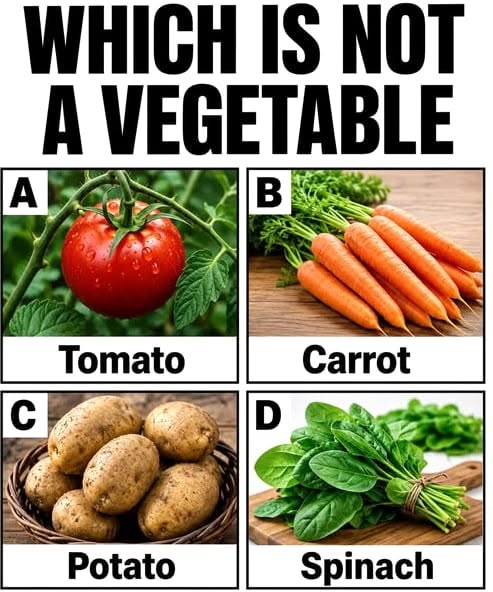
The direct answer is this: a tricky vegetable question is usually testing the difference between kitchen language and plant science. In the common set of choices, tomato, carrot, potato, and spinach, tomato is the usual trick answer when the hidden question is “which one is botanically a fruit?” But that is not the only possible answer. Carrot is the thickened root, spinach is the leaf, and potato is a tuber. A fair quiz has to tell you which classification it wants. Without that clue, the best solving move is not to guess harder, but to ask what category the question is really using.
The Puzzle Behind the Puzzle
Vegetable trivia feels simple because the words are familiar. Most people have handled these foods, cooked with them, or seen them grouped together in a grocery aisle. That familiarity is exactly why the question can be tricky. A quiz may use “vegetable” in the ordinary cooking sense, where tomato, carrot, potato, and spinach can all sit comfortably in the same mental basket. Then, with one quiet twist, it may switch to a botanical question about the part of the plant being eaten. The answer changes as soon as the lens changes.
That is why a bare multiple-choice list is not enough. “A. Tomato B. Carrot C. Potato D. Spinach” is only a set of options, not a complete question. If the missing question is “which one contains seeds and develops as a fruit?” tomato is the standout. The University of California Agriculture and Natural Resources notes that the common garden tomato is botanically classified as a fruit, even though many people think of it as a vegetable: UC ANR tomato guidance. If the missing question is “which one is a leaf?” the answer is spinach. The trick is not in memorizing one answer; it is in noticing the classification system.

Why Tomato Is the Classic Trick Answer
Tomato is the famous quiz answer because it exposes the gap between two everyday meanings. In botany, a fruit is tied to the seed-bearing structure of a flowering plant. In cooking, the word vegetable often means a savory plant food used in salads, sauces, soups, or side dishes. Tomato lives in both worlds. It is treated like a vegetable in many kitchens, but in plant-part terms it belongs with fruits. Illinois Extension’s plant-part teaching page lists tomato under fruits, alongside cucumber and other seed-bearing foods: Illinois Extension plant parts.
This does not mean the everyday phrase “tomato is a vegetable” is useless. It means the phrase is context-dependent. In a recipe, a tomato can be discussed as a vegetable because that is how cooks commonly use it. In a science quiz, tomato becomes the answer that reveals whether the solver noticed the category shift. Good quiz design makes that shift clear enough to be satisfying, not so vague that every answer can be defended.

A Plant-Part Cheat Sheet for the Four Choices
The easiest way to solve many vegetable riddles is to name the plant part before choosing the answer. This turns the question from a memory test into a sorting task. Here is a quick guide for the four familiar choices:
- Tomato: Botanically a fruit because it is the seed-bearing part of the plant, though it is commonly used as a vegetable in cooking.
- Carrot: A thickened root. Illinois Extension describes carrot as a cool-season plant grown for the thickened root it produces in its first growing season: Illinois Extension carrots.
- Potato: A tuber. University of Minnesota Extension explains that potato tubers form on stolons that emerge from the main stems: UMN Extension potatoes.
- Spinach: A leaf vegetable. Illinois Extension’s spinach page discusses fresh spinach leaves for salads, sandwiches, casseroles, and other dishes: Illinois Extension spinach.
Once you know those four labels, many quiz questions become much easier. “Which one is not a root?” could be tomato, potato, or spinach depending on how the answer set is framed. “Which one is a leaf?” points to spinach. “Which one is a tuber?” points to potato. “Which one is the botanical fruit?” points to tomato. The wording matters more than the ingredient list.
Food Groups Add a Second Layer
Some quizzes become trickier because they mix botany with food-group language. The USDA Food Buying Guide organizes vegetables into subgroups such as dark green, red/orange, beans, peas and lentils, starchy, and other vegetables: USDA Food Buying Guide vegetables. That system is not trying to settle a botany debate. It is a practical food-service classification. Under that kind of framework, a tomato can be treated as a vegetable for menu planning even while botany still describes it as a fruit.
Quiz Tip
When a question seems too easy, pause before answering. Ask whether the quiz is using kitchen categories, plant parts, food groups, or wordplay. The same ingredient can move between categories depending on the rule being tested.

How to Read the Wording Like a Solver
A strong solver reads the verb and the category words first. “Which is a fruit?” is not the same as “which is eaten as a vegetable?” “Which grows underground?” is not the same as “which is a root?” Potato grows underground, but it is not a root in the same way carrot is. Spinach grows above ground, but the useful clue is that the part usually eaten is the leaf. Tomato may grow on a vine and be used in savory dishes, but the seeds inside point to the botanical-fruit answer.
This is also where contradiction checking helps. If two answers seem possible, restate the question with the category made explicit. For a broader puzzle-solving method, see How to Use Two Questions to Check for Contradictions. The same approach works here: first ask, “What rule would make only one answer correct?” Then ask, “Does the wording actually name that rule?” If it does not, the quiz may be relying on an assumed trick rather than a well-written clue.
A Fair Answer Key for the Common Version
If the quiz shows only tomato, carrot, potato, and spinach, the most likely intended answer is tomato. That is the familiar trick because tomato is usually discussed as a vegetable in kitchens but is botanically a fruit. Still, a careful answer key should say what the hidden question was. A better version would ask, “Which of these common kitchen vegetables is botanically a fruit?” That makes tomato the clean answer. Another better version would ask, “Which one is a leaf vegetable?” That makes spinach the clean answer. Precision turns a gotcha into a real learning moment.
Cooking language remains useful, too. In a kitchen context, all four choices can belong in the broad vegetable conversation. That is why a cooking page can group plant foods by flavor, texture, or use rather than by strict botany. If you want a food-context example, compare how vegetables work together in a dish such as Vegetable Beef Soup. A quiz asks for categories; a recipe asks how ingredients behave together.
How to Make Your Own Better Vegetable Quiz
If you are writing a quiz for friends, a classroom, or a family game night, make the trick fair. A fair tricky question gives solvers enough information to change their frame of reference. Instead of asking “Which one is the vegetable?” ask “Which one is a root vegetable?” or “Which one is botanically a fruit?” Instead of hiding the rule completely, let the challenge be recognizing and applying it. That way, people learn why the answer works instead of simply feeling caught out.
You can also vary the difficulty by mixing categories. An easy round might ask for the plant part: root, leaf, fruit, tuber. A medium round might ask for the culinary use: salad green, soup base, baked side, sauce ingredient. A harder round might ask solvers to explain why two labels can both be true. Tomato is the best example: it can be botanically a fruit and culinarily treated as a vegetable. The correct answer depends on the rule the question declares.
Article Summary
The classic tricky vegetable quiz is less about vegetables than about categories. Tomato is usually the intended answer when the hidden test is botanical fruit versus kitchen vegetable. Carrot points to a root, spinach to a leaf, and potato to a tuber. Before choosing, read the wording for the rule. If the rule is missing, the question is incomplete, and the honest answer is that more information is needed.
Common Questions
What is the answer to the tricky vegetable question with tomato, carrot, potato, and spinach?
If the intended question is “which one is botanically a fruit?” the answer is tomato. If the question is asking for a root, the answer is carrot. If it asks for a leaf, the answer is spinach. If it asks for a tuber, the answer is potato. Without the actual wording, the list alone is incomplete.
Why is tomato often used as the trick answer?
Tomato is often used because it has two familiar labels. In everyday cooking, people commonly treat it as a vegetable. In botany, it is a fruit because it is the seed-bearing part of the plant. That category switch makes it a natural trivia trap.
Is potato a root vegetable in this kind of quiz?
In casual speech, people sometimes group potatoes with root vegetables because they grow underground. In plant-part terms, however, a potato is a tuber. A quiz that wants strict plant science should distinguish potato from a true root such as carrot.
How can I tell if a vegetable quiz is fair?
A fair quiz names the rule clearly enough that one answer is best. It might ask for a botanical fruit, a root, a leaf, a tuber, or a food-group category. If the wording does not identify the rule, more than one answer may be defensible.
What is the best strategy for solving tricky food trivia?
First identify the category being tested: cooking use, plant part, food group, language clue, or comparison. Then check each option against that category. This keeps you from answering based only on habit or the way the food is usually used in the kitchen.
Article References
Trusted sources help support the cooking guidance, ingredient advice, and kitchen tips in this article.
- https://ucanr.edu/node/134366/printable/print
- https://web.extension.illinois.edu/gpe/case1/c1f-ans.html
- https://extension.illinois.edu/gardening/carrots
- https://extension.umn.edu/garden-and-home/yard-and-garden/gardening-in-minnesota/growing-potatoes
- https://extension.illinois.edu/gardening/preparing-spinach
- https://foodbuyingguide.fns.usda.gov/FoodComponents/ResourceVegetables