
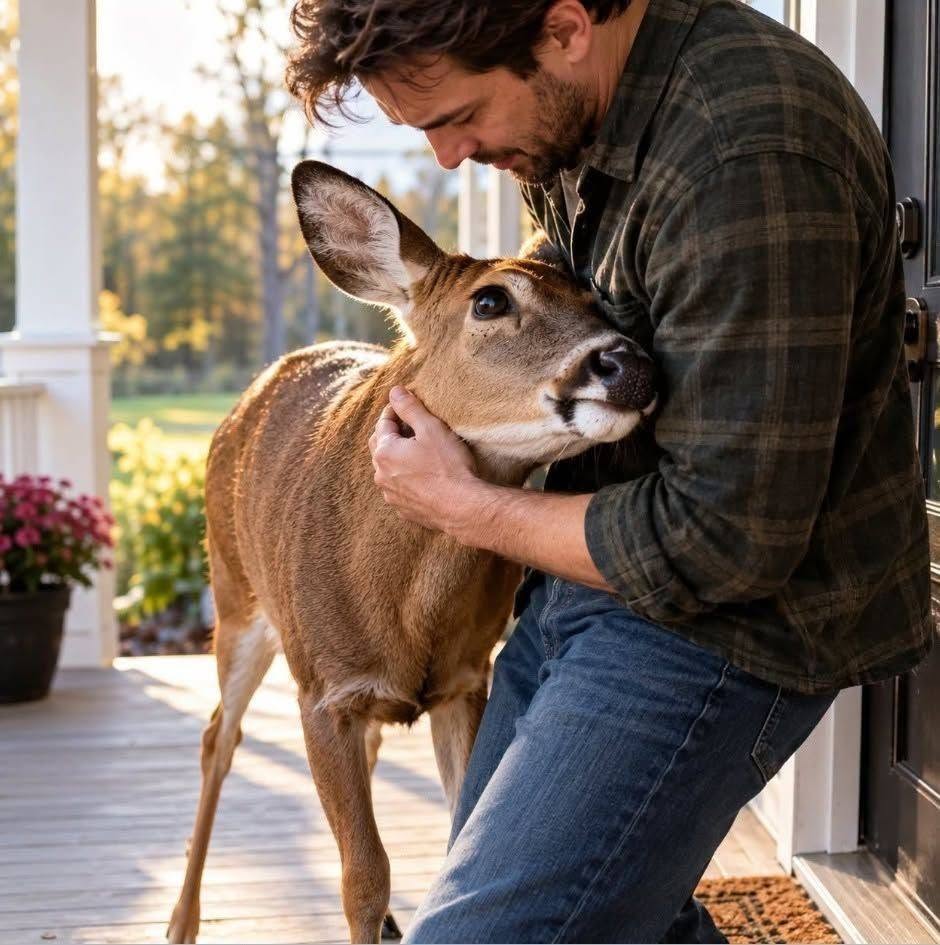
The deer hit my front porch hard enough to rattle the flowerpots.
I opened the door expecting a loose dog.
Instead, a full-grown white-tailed doe stood three feet from me, breathing so fast I could see her ribs moving.
Then she stepped forward and pressed the side of her face against my leg.
I backed away.
She followed.
That was the moment I made my first mistake.
My name is Daniel Reeves.
At the time, I lived with my seventy-four-year-old father on ten wooded acres outside Knoxville, Tennessee.
Dad had spent most of his life working construction, fixing fences, rebuilding barns, and noticing things I usually walked past.
Tracks in mud.
Broken branches.
Changes in bird calls.
I had inherited none of that patience.
That afternoon, I was inside answering work emails when I heard hooves on the porch.
Not walking.
Stomping.
I opened the door and saw the doe.
She should have run the second she saw me.
She didn’t.
Her coat was damp with sweat.
Her eyes were wide.
Her sides heaved.
She pushed her nose toward my hand.
Then turned her head sharply toward the side yard.
Back to me.
Side yard.
Me.
I thought she was confused.
Possibly sick.
Maybe injured.
“Go on.”
I waved both hands.
She stepped closer.
“Go.”
I pushed gently against her shoulder.
She moved back half a step.
Then returned.
Harder this time.
Her body pressed against my thigh.
Her front hoof struck the porch.
Ounce.
Twice.
The sharp cracks made my heart jump.
“Hey!”
I shoved her away more firmly.
She stamped again.
For a second, I thought she was going to rear up.
Every warning I’d never heard about wild animals flashed through my head.
Don’t touch them.
Don’t corner them.
Don’t mistake calm for tame.
I retreated into the house and shut the door.
The doe stayed outside.
Five minutes.
Ten.
Twenty.
I looked through the window.
She had not moved.
Her head hung lower now.
She starred directly at the door.
There was something in her expression I couldn’t name.
Not aggression.
Not curiosity.
Desperation.
Dad appeared beside me.
“What would you do?”
“Why do you assume I did something?”
“Because there’s a deer glaring through the window like you owe her money.”
I laughed despite myself.
Then the doe stomped again.
Dad stopped smiling.
He watched her.
Longer than I had.
“She keeps looking toward the back.”
“So?”
“So maybe you should stop assuming she’s here for you.”
“What does that mean?”
Dad pulled on his boots.
“Means I’m going outside.”
“Dad, she almost charged me.”
“No, she scared you.”
“There’s a difference?”
“Yes.”
He opened the door.
The doe immediately stepped toward him.
Dad didn’t reach for her.
Didn’t wave.
He simply stood there.
She sniffed the air.
Then turned.
Walked down the steps.
Stopped.
Looked back.
Dad followed.
The doe walked around the side of the house.
Stopped again.
Looked back again.
That was when I finally understood.
“She wants you to follow her.”
Dad glanced over his shoulder.
“Now you’re catching up.”
I grabbed my jacket.
The doe led us behind the garage, past the garden, toward the back of our property.
We had an old wrought-iron gate there that separated the yard from a strip of woods.
It had been installed decades before we bought the place.
Tall black bars.
Decorative curls.
Too narrow in places.
I had always hated the thing.
The doe stopped fifteen feet away.
Then I heard it.
A tiny cry.
High.
Thin.
Weak.
Dad moved first.
We rounded the hedge.
My stomach dropped.
A fawn was trapped halfway through the gate.
It couldn’t have been more than a few weeks old.
Its spotted body was wedged between two iron bars.
One front leg had made it through.
The other was pinned backward.
Its hind quarters remained on the other side.
Every time it tried to pull free, the bars dug deeper into its sides.
Raw red scrapes ran along its ribs.
It had clearly been struggling for a long time.
The doe stepped beside Dad.
Completely different now.
No stomping.
No frantic movement.
She simply stood there watching him.
I looked at her.
Then at the fawn.
And every time I had shoved her away replayed in my mind.
“She was asking for help.”
Dad didn’t answer.
He crouched near the gate.
The fawn began fighting harder.
“Easy.”
Its legs kicked.
Dad immediately backed away.
“Daniel, get me a sheet.”
“What?”
“White sheet. Garage shelf.”
I ran.
When I returned, Dad folded the cloth slowly.
He approached from the side.
The mother deer watched every movement.
She didn’t run.
Dad draped the cloth gently over the fawn’s eyes.
Almost immediately, the struggling slowed down.
“Why does that work?”
“Less to react to.”
He examined the bars.
Then the legs.
His expression changed.
“What?”
“One leg is twisted.”
“Broken?”
“I don’t know.”
I reached toward the gate.
Dad grabbed my wrist.
« Of which. »
“We have to get it out.”
“We do.”
“Then let’s pull the bars apart.”
He shook his head.
“If that leg is caught the way I think it is, pulling the wrong direction could snap it.”
Behind us, the doe gave one low, trembling sound.
Dad looked at me.
Then at the small body trapped in the iron.
“We only get one clean chance at this.”
And suddenly I understood why the deer had refused to leave my porch.
She had found the one animal she couldn’t rescue herself—and somehow decided one of us had to be smart enough to listen.
Dad slid one hand beneath the fawn’s chest.
“Hold the cloth.”
I moved beside him.
The fawn trembled beneath my fingers.
Up close, it seemed impossibly fragile.
Thin legs.
Soft spotted coat.
Heart pounding so fast I could feel it through the fabric.
The doe stood perhaps twelve feet away.
Watching.
I kept expecting her survival instincts to take over.
Run.
Charge.
Do something.
She did nothing.
Dad examined the trapped leg again.
“The hoof went through first.”
“So?”
“So it twisted when the body turned.”
He pointed.
“If we pull backward, we make it worse.”
“What do we do?”
“We move the body forward first.”
The gap looked far too narrow.
Dad placed his shoulder against a bar.
“Put pressure here.”
I leaned into the next one.
The old iron barely moved.
Dad grunted.
“Again.”
We pushed.
The gap widened perhaps half an inch.
“That’s enough.”
He supported the fawn’s chest.
“Daniel, when I lift, guide the shoulder through.”
“What about the leg?”
“I’ve got it.”
The fawn began struggling again.
The mother took one step forward.
Dad spoke without looking up.
“Easy, mama.”
His voice was the same one he used when I was a kid and panicked during thunderstorms.
Low.
Steady.
No wasted words.
“Now.”
He lifted.
I guided the fawn forward.
Its shoulder cleared the first bar.
Then stopped.
The trapped leg tightened.
The little animal cried.
The doe answered.
My hands started shaking.
“Dad—”
“Don’t rush.”
“It’s hurting.”
“I know.”
He adjusted the hoof.
One inch.
Then another.
I watched him work.
Seventy-four years old.
Arthritic hands.
Bad right knee.
More patient than I had ever been in my life.
The hoof turned.
“Push the body.”
I pushed.
The leg came free.
Suddenly the entire fawn slipped forward.
Dad caught it against his chest before it hit the ground.
For several seconds, none of us moved.
The fawn lay completely still in his arms.
My stomach tightened.
“Is it okay?”
“Give it a second.”
He ran his hands carefully along each leg.
Shoulders.
Back.
Ribs.
The raw areas looked painful, but there was no obvious deep wound.
Then one tiny hoof kicked.
Dad smiled.
“There you are.”
He lowered the fawn onto the grass.
The sheet slipped away from its face.
Huge dark eyes opened.
It looked at Dad.
Then at me.
Then past us.
The doe.
The fawn tried to stand.
Its legs folded.
The mother took another step.
I wanted to help.
Dad stopped me.
“Let it try.”
The fawn pushed again.
Front legs first.
Then back.
It stood.
Wobbled.
Nearly fell.
Then found balance.
The doe made a soft sound.
The fawn’s ears lifted.
It ran.
Not fast.
Not gracefully.
But with everything it had.
Straight toward her.
The mother moved at the same time.
They met halfway across the yard.
The fawn pressed beneath her neck.
The doe lowered her head and touched its back with her nose again and again.
I had seen deer my whole life.
At the edge of highways.
Across fields.
In hunting season photographs.
Never like this.
Never close enough to see relief in movement.
Maybe “relief” is too human a word.
I don’t know.
But something changed in the doe’s entire body when that fawn reached her.
She went from tight and alert to almost still.
Then she turned toward us.
For several seconds, she stared.
I wanted desperately to believe she understood what we had done.
Maybe she did.
Maybe she was simply assessing whether we were still dangerous.
Dad never liked people forcing human emotions onto animals.
“She doesn’t owe us a thank-you,” he said quietly.
“I didn’t say anything.”
“You were thinking loudly.”
I smiled.
The doe turned.
The fawn followed.
They crossed the open field behind our house.
The setting sun turned the grass gold.
Near the tree line, the fawn stumbled once.
Recovered.
Then both disappeared into the woods.
I kept staring after them.
Dad began picking up the sheet.
“That’s it?”
“What were you expecting? A card?”
I laughed.
Then looked at the gate.
“We need to fix that.”
Dad nodded.
“Tomorrow.”
“No. Today.”
He looked at me.
That earned the smallest smile.
We removed the entire center section before dark.
The next weekend, I replaced it with a wildlife-friendly fence.
No decorative narrow gaps.
No pointed metal.
Nothing a young animal could easily wedge itself through.
It cost more than I wanted.
I never regretted a dollar.
For several days, I kept thinking about the doe on the porch.
The part that bothered me wasn’t that I had been frightened.
Fear was reasonable.
She was a wild animal acting strangely.
What bothered me was how quickly fear became certainty.
I had decided she was aggressive.
Decided she was dangerous.
Decided I understood what was happening.
Dad had looked at exactly the same animal and asked a different question.
What if I’m reading this wrong?
That difference saved the fawn.
A week later, I asked him how he knew.
We were sitting on the porch.
Same place where the deer had stood.
“I didn’t.”
“That’s not an answer.”
“It’s the only honest one.”
“You knew enough to follow her.”
Dad took a sip of coffee.
“She kept looking toward the back.”
“I saw that.”
“You saw it. You didn’t notice it.”
That annoyed me because it was true.
He continued.
“Animals repeat things when the first attempt doesn’t work.”
“How do you know that?”
“Kids do too.”
I looked at him.
He smiled.
“Especially you.”
For years, my father and I had loved each other badly.
Not violently.
Not dramatically.
Just quietly.
My mother died when I was thirty.
Afterward, Dad became even more reserved.
We could spend an entire afternoon repairing something and exchange maybe fifty words.
I mistook silence for distance.
He probably mistook independence for not needing anything.
Living together had been practical.
His house was too much for him alone.
My divorce had made mine unnecessary.
We never talked about either reason.
That afternoon, I realized something uncomfortable.
I had treated Dad the same way I treated the doe.
I saw behavior.
Made an assumption.
Stopped looking deeper.
He went quiet, so I assumed he wanted space.
He didn’t ask for help, so I assumed he didn’t need it.
Maybe we humans weren’t nearly as easy to understand as we liked to believe.
Two months passed.
Summer thickened the woods.
I thought about the fawn less often.
Then one morning Dad called from the kitchen.
“Daniel.”
I came downstairs.
He pointed through the back window.
At the edge of the field stood a doe.
Beside her was a young fawn.
Bigger now.
Its spots fading.
I froze.
“You think that’s them?”
Dad shrugged.
“Could be.”
The fawn lowered its head to the grass.
The doe scanned the field.
For perhaps thirty seconds, they remained there.
Then they moved into the trees.
I wanted confirmation.
A scar.
A mark.
Something that made the story neat.
There was none.
And eventually I realized it didn’t matter.
Maybe it was the same pair.
Maybe not.
The important part had already happened.
That mother deer had overcome every instinct telling her humans were dangerous.
She had approached a house.
Allowed herself to be pushed away.
Returned.
Waited.
Tried again.
Not because she trusted me.
Certainly not at first.
Because something mattered more than fear.
Her fawn.
People often tell the story as though the miraculous part was that a wild deer “asked humans for help.”
Maybe.
But the part I remember most is how close I came to never understanding.
She could not explain.
She could only repeat.
Push against me.
Look back.
Stomp.
Wait.
Try again.
And eventually someone paid attention.
Dad died three years later.
Quietly.
At home.
His chair still faces the back field.
I kept the house.
I kept the porch.
And I kept the safe fence we built together.
Sometimes deer cross the property at dusk.
Whenever one stops near the tree line, I think about him crouched beside that iron gate with a frightened fawn in his hands.
People called what he did heroic when I told the story.
He hated that word.
He would have said he simply noticed what needed doing.
Maybe that was his gift.
Not bravery.
Attention.
The older I get, the more valuable I think that is.
Because the world is full of things asking to be understood without having the words to explain themselves.
Animals.
Children.
Parents.
Friends.
Sometimes even ourselves.
That afternoon, the doe didn’t teach me that wild animals can magically speak to humans.
She taught me something harder.
Communication can fail even when the message is right in front of us.
And love—whether animal or human—sometimes looks less like knowing exactly what to do and more like refusing to leave until somebody finally understands.
I pushed that deer away three times.
She came back three times.
If she had given up after the first—
her baby might have died against that iron gate.
Instead, she waited until the right person opened the door.
For years, I thought that person was my father.
Now I understand why he followed her.
He had spent his whole life learning that when someone who cannot explain themselves keeps coming back—sometimes the most important thing you can do is stop pushing them away and finally ask where they need you to go.