
Decoding the Viral Math Riddle: A Step-by-Step Guide
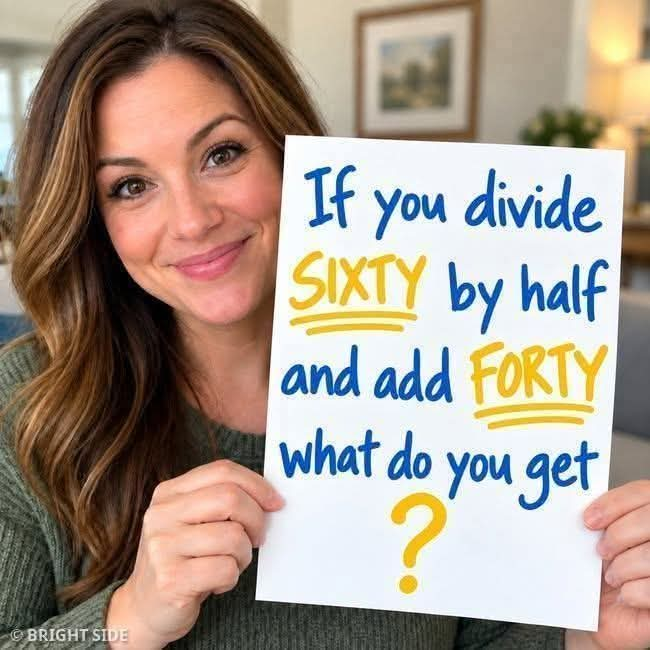
Math riddles have a unique way of capturing our attention, often going viral across social media platforms as people debate their solutions. One such riddle, prominently displayed on a white card by a smiling woman in a recent viral image, asks: “If you divide SIXTY by half and add FORTY, what do you get?” This seemingly simple question often trips people up due to a common misunderstanding of mathematical terminology. Let’s break down this intriguing puzzle and uncover the correct answer, enhancing your mathematical intuition along the way.
Why This Riddle Is So Tricky
The primary reason this math riddle is so effective at stumping people lies in the phrasing “divide by half.” Many individuals instinctively interpret “divide by half” as dividing by two (÷ 2). However, this is where the crucial distinction lies. Dividing by half is not the same as dividing by two. Instead, dividing a number by half (or 1/2) is equivalent to multiplying that number by two. This subtle linguistic and mathematical nuance is what makes the riddle a clever test of both arithmetic skills and careful reading.
Understanding “Dividing by Half”
- Common Misinterpretation: Many people think “divide by half” means 60 ÷ 2 = 30.
- Correct Interpretation: “Half” as a number is 0.5 or 1/2. So, dividing by half means dividing by 0.5 or 1/2.
- The Rule: When you divide by a fraction, you multiply by its reciprocal. The reciprocal of 1/2 is 2/1, or simply 2.
- Example: 60 ÷ (1/2) = 60 × 2.
The Step-by-Step Solution
To correctly solve the riddle, we need to follow the order of operations and interpret the phrase “divide by half” accurately.
Step 1: Divide SIXTY by Half
As established, dividing by half is the same as multiplying by two. So, the first part of the riddle is:
60 ÷ (1/2) = 60 × 2 = 120
Step 2: Add FORTY to the Result
Once you have the result from the first step, you simply add forty to it:
120 + 40 = 160
The Final Answer
Therefore, if you divide sixty by half and add forty, you get 160.
Why Engaging with Riddles Matters
Beyond just solving a puzzle, engaging with math riddles offers several cognitive benefits:
- Enhances Critical Thinking: Riddles force you to think outside the box and consider different interpretations of language and numbers.
- Improves Problem-Solving Skills: They provide a low-stakes environment to practice breaking down complex problems into manageable steps.
- Boosts Mathematical Fluency: Regularly solving riddles can reinforce fundamental mathematical concepts and operations.
- Stimulates Brain Activity: Puzzles are a great way to keep your mind sharp and engaged, regardless of age.
- Encourages Discussion: Viral riddles often spark conversations and debates, fostering a sense of community and shared intellectual challenge.
Common Pitfalls and How to Avoid Them
Understanding where people typically go wrong can help you avoid similar mistakes in the future, not just with riddles but with everyday problem-solving.
Misinterpreting Language
Words like “half,” “double,” “triple,” “of,” and “per” can have specific mathematical meanings that differ from their colloquial use. Always pause to consider the precise mathematical operation implied.
Rushing to an Answer
Many riddles are designed to lead you to a quick, incorrect answer. Taking a moment to break down the problem and write out the steps can prevent errors.
Ignoring Order of Operations
While this particular riddle’s operations are sequential, more complex puzzles might require adherence to the order of operations (PEMDAS/BODMAS) to arrive at the correct solution.
Frequently Asked Questions About Math Riddles
Q: Are all math riddles designed to trick you?
A: Many popular math riddles, especially those that go viral, often include clever phrasing or misdirection to make them more challenging and engaging. They test not just your math skills but also your attention to detail and critical interpretation.
Q: How can I get better at solving math riddles?
A: Practice is key! Regularly engage with different types of puzzles, pay close attention to the wording, and try to break down problems into smaller, more manageable parts. Understanding common mathematical terms and their precise definitions is also very helpful.
Q: What’s the difference between a math riddle and a math problem?
A: A math problem typically presents a straightforward calculation or scenario to solve. A math riddle, while involving numbers, often uses language creatively to obscure the direct path to the solution, requiring more interpretive and critical thinking.
Q: Why do these riddles become so popular on social media?
A: Their popularity stems from several factors: they are often short and shareable, they provide an immediate mental challenge, and they spark discussion as people share their answers and reasoning. The satisfaction of solving one, or the frustration of being stumped, encourages engagement.
Final Thoughts
This “divide by half” riddle is a fantastic example of how a simple mathematical concept can be presented in a way that challenges our assumptions and makes us think twice. It reminds us that precision in language is as important in mathematics as precision in calculation. So, the next time you encounter a seemingly straightforward math puzzle, take a moment to consider every word. You might just surprise yourself with the correct, and often unexpected, answer!